Polish Citizenship by Descent
(Jus Sanguinis)
A complete legal guide to the requirements, legislation, and process for confirming Polish citizenship by descent under the Act of 2 April 2009.
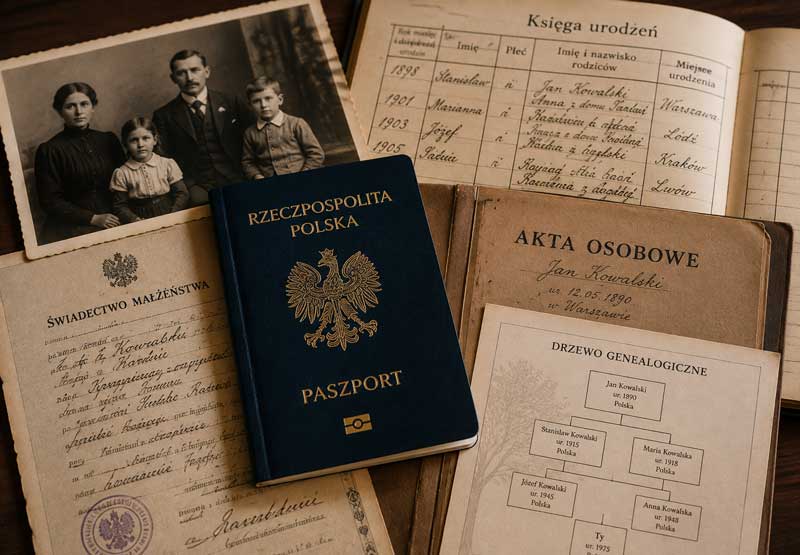
The Legal Basis
Polish citizenship by descent is grounded in the principle of jus sanguinis (right of blood), as codified in the currently applicable Act of 2 April 2009 on Polish Citizenship. Under the fundamental principle set out in Article 2 of the Act, citizenship acquired under earlier legislation is preserved over time, irrespective of subsequent legislative changes, provided no lawful loss of it has occurred.
A child automatically acquires Polish citizenship at birth if at least one parent held Polish citizenship at the time of the child’s birth — regardless of the child’s place of birth, whether within or outside Polish territory.
No statutory limit is placed on the number of generations that may separate the Polish ancestor from today’s applicant, provided the essential condition is met: that the genealogical chain of transmission of citizenship remains unbroken — meaning that no intermediate member of the family line lost Polish citizenship before the birth of the next link in the chain.
Confirmation of Citizenship, Not Naturalization
Competent Authority & Place of Filing
The application is filed with the competent voivode (wojewoda) — the governor of the Polish administrative province corresponding to the applicant’s or the ancestor’s last place of residence in Poland. If there is no such point of reference, the competent authority is the Voivode of Mazovia (Wojewoda Mazowiecki), based in Warsaw. For applicants residing outside Poland, the application may be filed through the competent Polish consulate in their country of residence.
Required Documents (indicative)
- The applicant’s full birth certificate, showing the parents’ details.
- Birth and marriage certificates for every person in the genealogical chain.
- Documents establishing the ancestor’s Polish citizenship (e.g. Polish passport, identity card, military record book).
- The applicant’s civil-status certificate (marriage, divorce, widowhood, as applicable).
- An official Polish translation of every foreign-language document, by a sworn translator or through consular certification.
- An apostille where required, under the Hague Convention.