Loss of Citizenship — Loss Events
An unbroken genealogical chain is an essential requirement for confirming Polish citizenship by descent. It is not enough to prove that an ancestor was a Polish citizen — it must also be shown that no intermediate member of the family line lost citizenship before the birth of the next link in the chain.
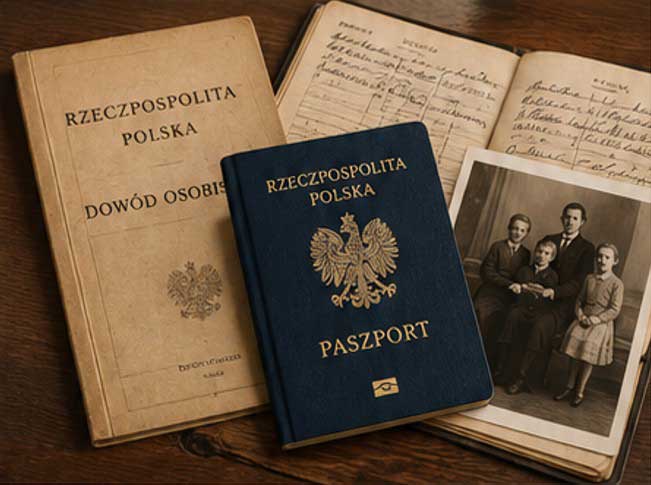
Main Grounds for Loss of Citizenship
- Voluntary naturalization in a foreign state, when it occurred before the birth of the next descendant in the genealogical line.
- Enlistment in foreign armed forces without prior authorization from the competent Polish authorities — particularly critical for the 1920–1951 period, as discussed in the section on the 1920 Law.
- Assumption of public office in a foreign state under certain conditions, under the legislation in force at the relevant time.
- Express renunciation of Polish citizenship, following the relevant approval of the competent authorities.
The World War II Exception
Military service with Allied forces during World War II is treated, under settled case law, as a special case that does not automatically result in loss of Polish citizenship, since it was found to be consistent with Poland’s national interest.
The Residence Registration Element (Meldunek)
During the 1930s, official municipal residence registration (meldunek) often served as indirect evidence of possession of Polish citizenship. The presence or absence of such a registration can be an important piece of evidence during archival research.
Why These Cases Need Specialist Review
Determining whether a specific historical event actually resulted in loss of citizenship depends on the precise legislative regime in force at that particular time, the type of military service involved, and whether naturalization occurred before or after the birth of the next descendant. For this reason, every case involving a potential historical issue of loss of citizenship is assessed individually before full archival research begins.
Related Citizenship Topics
Official Government Sources
Not sure if you qualify?
Our team, working with Polish-admitted lawyers, will review your situation and guide you through every step.