The 1920 Law & Historical Legislative Periods
A Legal History of Polish Citizenship
Understanding the four legislative periods that have governed Polish citizenship since 1920 is essential for evaluating modern citizenship by descent cases.
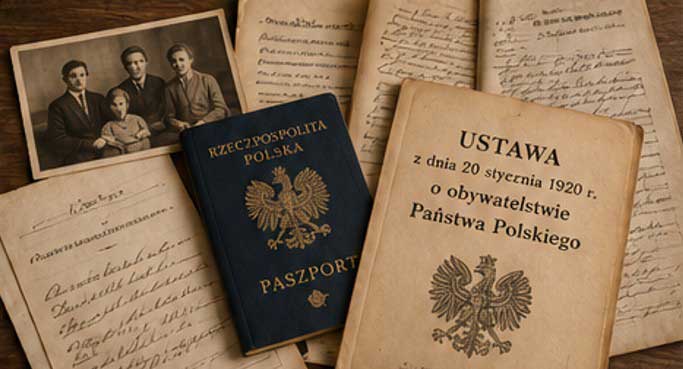
Act of 20 January 1920 on the Citizenship of the Polish State
It entered into force on 31 January 1920 and was the first unified legislative framework on citizenship following the restoration of Polish independence in 1918. It automatically granted Polish citizenship to permanent residents of the reconstituted Polish state. Under Article 5 of this Act, legitimate children acquired their father’s citizenship, while children born out of wedlock acquired their mother’s citizenship.
Of particular importance for present-day cases is Article 11 of the Act, which provided for loss of Polish citizenship in the event of enlistment in a foreign armed force without prior authorization from the competent Polish authorities, as well as in the event of naturalization in a foreign state.
The "Military Paradox" Phenomenon (1920–1951)
During the period from 31 January 1920 to 18 January 1951, enlistment in a foreign army generally resulted in loss of Polish citizenship — regardless of the individual’s intent and regardless of whether the service was compulsory or voluntary. At the same time, many immigrants who naturalized in countries such as the United States or Canada continued to be regarded, under Polish law, as Polish citizens until they were formally released from their military obligation toward Poland — hence the term “military paradox” used in the legal literature.
A protective provision was nonetheless in place: legitimate children did not lose Polish citizenship if they had already reached the age of majority before their father lost his citizenship.
Act of 8 January 1951 on Polish Citizenship
It entered into force on 19 January 1951, replacing the 1920 Act. From this legislative period onward, foreign military service ceased to constitute an independent ground for loss of Polish citizenship.
Act of 15 February 1962 on Polish Citizenship
It remained in force until replaced by the current 2009 Act, regulating the conditions for acquisition, loss, and restoration of Polish citizenship for most of the second post-war period.
Act of 2 April 2009 on Polish Citizenship (current law)
This is the legislative framework currently in force. It enshrines the principle of continuity of citizenship (Article 2): citizenship acquired under earlier legislation is preserved, provided no lawful loss of it occurred under the law in force at the time of the relevant event. It now expressly permits holding multiple citizenships, without requiring renunciation of another citizenship.
Practical Significance for Assessing a Case
Because the principle of continuity requires applying the law in force at the time of each event, a correct assessment of a case requires precise dating of every critical stage of the family history (the ancestor’s birth, emigration, naturalization, military service) against the four legislative regimes described above.
Related Citizenship Topics
Official Government Sources
Not sure if you qualify?
Our team, working with Polish-admitted lawyers, will review your situation and guide you through every step.